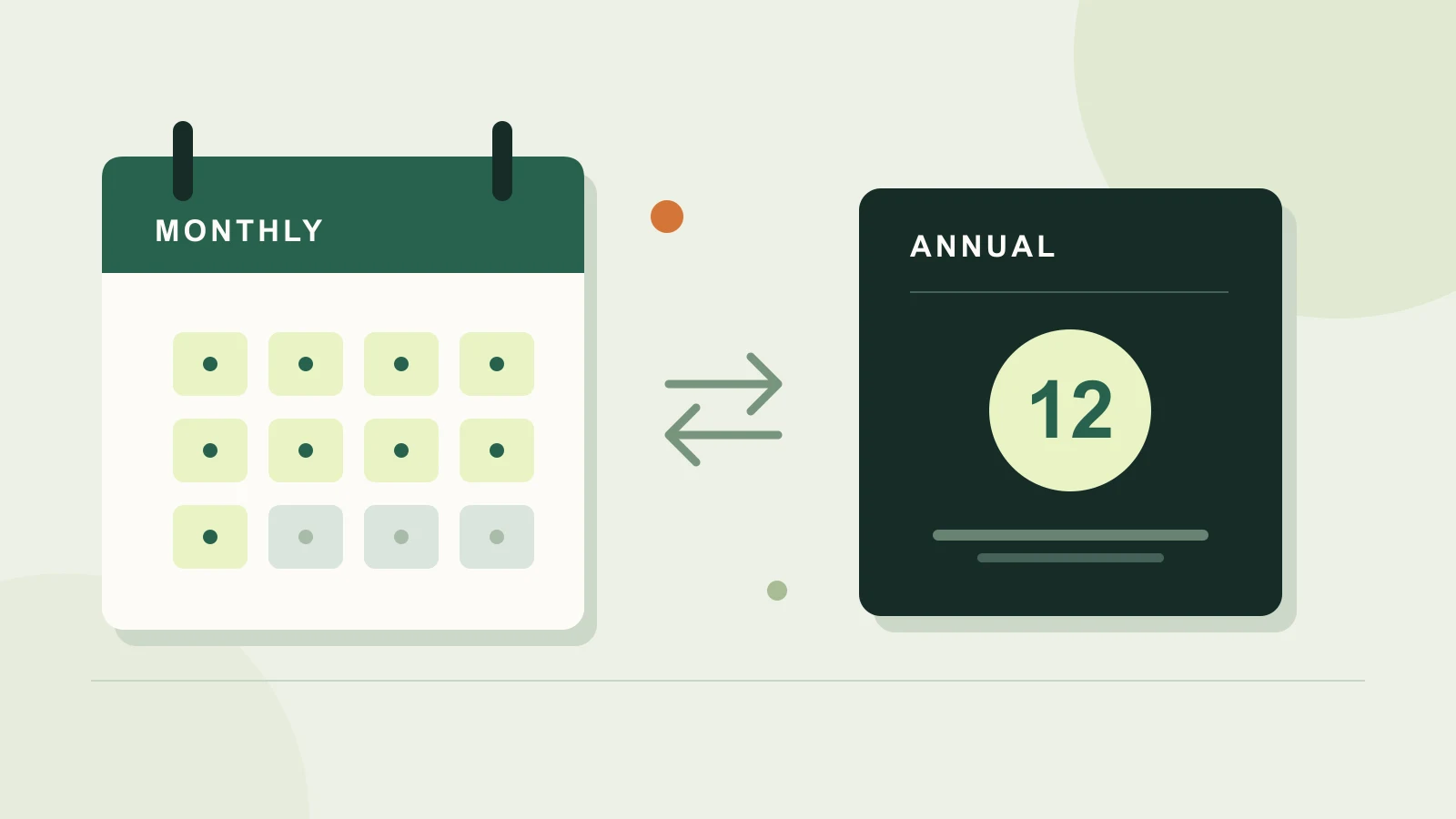
Start with the months you will actually use
An annual plan can show a lower monthly equivalent while still costing more than the monthly payments you would have made. Before paying for a year, compare the annual total with the number of months you realistically expect to need the service. Then check what you give up in flexibility.
This guide covers optional subscriptions such as entertainment and productivity apps. It is a comparison method, not a recommendation to cancel essential services, insurance, debt payments, or a contract you still owe. All dollar amounts below are invented examples, not current offers.
1. Put both offers on the same basis
Write down the actual annual charge and the monthly charge for the same features, account limits, and billing channel. A headline that says “$12 per month, billed annually” usually describes the equivalent cost, not twelve separate $12 payments. Confirm the amount due now at checkout.
- Plan: Are ads, storage, seats, devices, and other limits identical?
- Total: Include applicable taxes and mandatory fees in both options.
- Renewal: Is the displayed amount introductory, and what will the next term cost?
- Commitment: Is “monthly” genuinely month to month, or an annual contract paid in installments?
If the plans are different, identify the features you would actually use before comparing prices. Extra features you do not need do not automatically justify a higher payment. A discount percentage against a plan you would never buy is not a useful savings estimate.
2. Calculate the break-even point
Compare use within a single 12-month annual term. For this simple calculation, assume the monthly plan can be canceled between billing periods, its price stays constant, and both options provide the same service. Let A be the all-in annual cost and M the all-in monthly cost.
Break-even months = A ÷ M. Annual billing costs less only when the monthly payments you would otherwise make total more than A. If the result is a whole number, that number of monthly payments costs the same; annual becomes cheaper after it. If the result is a fraction, round up to find the first whole month when annual costs less. If A is at least 12 times M, annual offers no price advantage within that year; at exactly 12 times M, the full-year costs are equal.
For example, imagine a monthly plan costs $15 and an annual plan costs $144. The break-even calculation is $144 ÷ $15 = 9.6 months. Annual is cheaper if you would otherwise pay for at least ten months.
| Months needed | Monthly total | Annual payment | Lower cost |
|---|---|---|---|
| 4 months | $60 | $144 | Monthly, by $84 |
| 9 months | $135 | $144 | Monthly, by $9 |
| 10 months | $150 | $144 | Annual, by $6 |
| 12 months | $180 | $144 | Annual, by $36 |
The advertised full-year saving in this example is $36. Someone who needs the service for four months would instead spend $84 more by choosing annual billing. Use your likely paid months, not an automatic twelve-month assumption.
3. Give uncertainty a price
Make two estimates: the months you are fairly sure you will use, and a longer stretch you might use. If annual wins only in the optimistic case, monthly billing may be worth the flexibility. This matters for a short project, a seasonal hobby, a course you may finish early, or a new service you have barely tried.
In the example above, annual saves only $6 at ten months. Decide whether that potential saving is enough to justify paying $144 now. The answer depends on your needs and budget; a small arithmetic advantage does not make the commitment affordable.
If you start monthly and might switch later, compare the choices again on the switch date. Ask whether unused time is credited, whether a promotion still applies, and whether the annual term starts immediately. Do not assume the first monthly payment reduces the annual price.
4. Identify who actually bills you
The company providing an app and the company collecting payment can be different. Check the receipt and your account's billing page before changing anything.
- Apple billing: Apple's instructions explain how to cancel through the web or your device. If the subscription is missing, check the Apple Account on the receipt; if Apple is not billing it, identify the company shown on the statement. Apple's cancellation guide.
- Google Play billing: Google says uninstalling an app does not cancel its subscription. It also distinguishes stopping renewal from stopping payments already owed under a payment plan. Google Play's subscription guide.
- Direct billing: Read the provider's own cancellation, renewal, and refund terms. Do not assume an app-store procedure applies to a purchase made on the provider's website.
Canceling renewal and receiving a refund are separate questions. Confirm when access ends, whether any refund is available, and whether a minimum term remains. If the terms are unclear, get an answer from the billing provider before committing to the larger payment.
5. Keep a short decision record
A note or spreadsheet is enough. Record the service, billing provider, annual total, monthly total, break-even point, likely months needed, renewal date, and next action. Avoid storing passwords or full payment-card details in this worksheet.
The FTC's subscription guidance recommends understanding trial and cancellation terms, using reminders, and checking statements for unexpected charges. Set your review before the provider's deadline, allowing time to resolve a failed cancellation. Keep the confirmation and check the next statement.
Use three decisions:
- Annual: The same-feature comparison works, expected use exceeds break-even, the upfront payment fits, and the terms are acceptable.
- Monthly: Use is uncertain or short, flexibility matters, or the annual saving is too small to justify committing.
- Wait or skip: You do not yet need the service, cannot establish the full cost, or cannot find clear renewal and cancellation terms.
Common questions
What if there is a free trial?
Compare the paid periods you would otherwise need after the trial. Check when billing begins and whether choosing annual changes trial access. Do not count a free month as a paid month in your savings calculation.
What if the monthly price changes?
Add the actual expected payments rather than multiplying one promotional month by twelve. For example, three months at $8 followed by nine at $16 total $168, not $96. If the future price is unknown, label the comparison an estimate and check again before renewal.
What if I already paid for a year?
Use the current plan's terms to establish your options. Turning off the next renewal may prevent another term without recovering the payment already made. Record the end date so you can decide again when you have better evidence of how much you used the service.
A useful final check: Can you explain why annual is better using your expected use, the full payment, and the actual terms? If the answer relies only on the word “save” at checkout, do the comparison first.
Sources and scope
Official guidance checked November 9, 2026: FTC subscription guidance, Apple cancellation instructions, and Google Play subscription help. Provider terms can change. The cost model and examples are original calculations with the assumptions stated above.
Browse the Save Money collection or search all stories. Historical articles are marked separately and have not been revalidated by this guide.